📊 Did the model fail… or did the evaluation fail?
When a machine learning model underperforms in production compared to validation, we tend to blame data shift — and move on. But there’s a smarter way to handle it.
🔍 The real problem: Covariate shift (when the data distribution changes between training and production) isn’t an excuse — it’s a tool. If the age distribution in your test dataset differs from validation, you’re comparing apples to oranges.
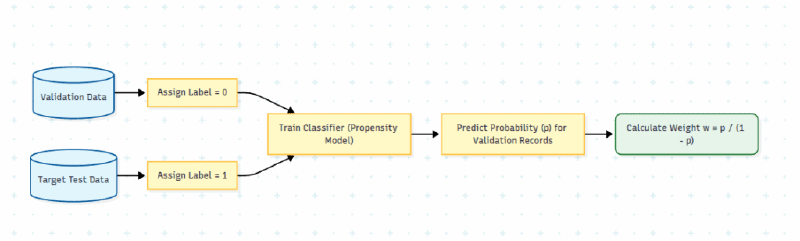
⚖️ The solution: Inverse Probability Weighting (IPW) Instead of filtering data, assign a continuous weight to each validation record so it statistically “looks like” the production dataset:
- Weight = 1 → standard analysis
- Weight = 0 → exclude the record
- Weight > 1 → amplify the record’s influence
For simultaneous shifts across multiple variables, train a binary classifier (propensity model) to distinguish between both datasets. Its probability output becomes the weights directly.
💡 In a nutshell#
Imagine you want to know how your model performs for patients aged 50–80, but your validation set contains patients aged 40–90. Instead of discarding rows, you give more “importance” to records similar to your target. This gives you an honest measurement of real-world performance — without throwing away data.
✅ The result: your weighted validation set becomes statistically indistinguishable from the production set. A concrete way to answer: “Is the model broken, or did the context simply change?”
More information at the link 👇