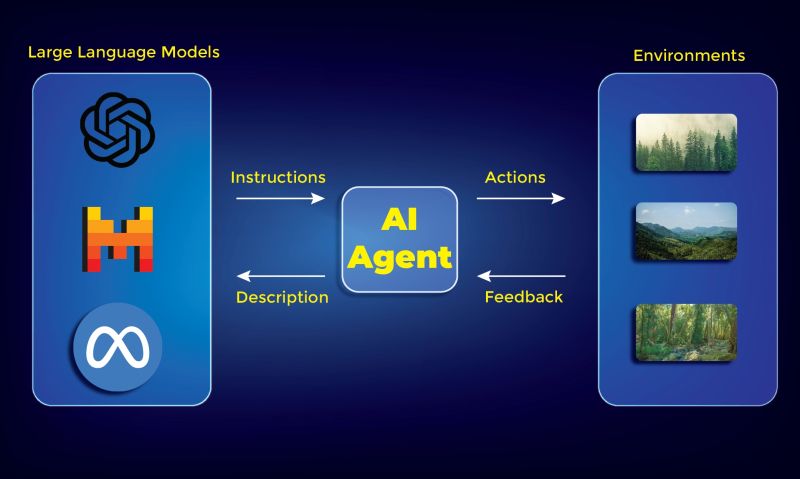
🚀 AI Agents in Python
Agentic frameworks are accelerating how we design and deploy autonomous systems.
🤖 What are these AI agent frameworks for? Imagine you want to create an “intelligent agent”:
- a program that thinks, decides, and acts on its own to help you perform tasks.
- These frameworks are toolboxes that make it easier to build these types of agents without having to program everything from scratch.
🧠 In summary: These frameworks allow you to create programs that think and act on their own, such as:
- An assistant that reads documents and summarizes everything for you
- A bot that writes code and tests it
- An agent that searches for information and answers you
- A team of agents that divide tasks among themselves Without these tools, you would have to program everything from scratch… and it would take forever.
Some examples
- LangChain – Broad integrations and agent module https://github.com/langchain-ai/langchain
- Microsoft AutoGen – Multi-agent collaboration and dynamic flows https://github.com/microsoft/autogen
- CrewAI – Lightweight, fast, and oriented towards collaborative intelligence https://github.com/crewAIInc/crewAI
- Haystack (Deepset) – Ideal for RAG and production applications https://github.com/deepset-ai/haystack
- SmolAgents (Hugging Face) – Minimalist and efficient for code agents https://github.com/huggingface/smolagents
- LangGraph – Orchestration of long-running agents https://github.com/langchain-ai/langgraph
- OpenAI Agents SDK – Multi-agent workflows with traceability https://github.com/openai/openai-agents-python
More information at the link 👇
Also published on LinkedIn.