TL;DR#
Machine learning integrates large volumes and varieties of subsurface data to produce predictive and descriptive models that optimize operations, reduce uncertainty, and generate economic impact when combined with expert domain knowledge.
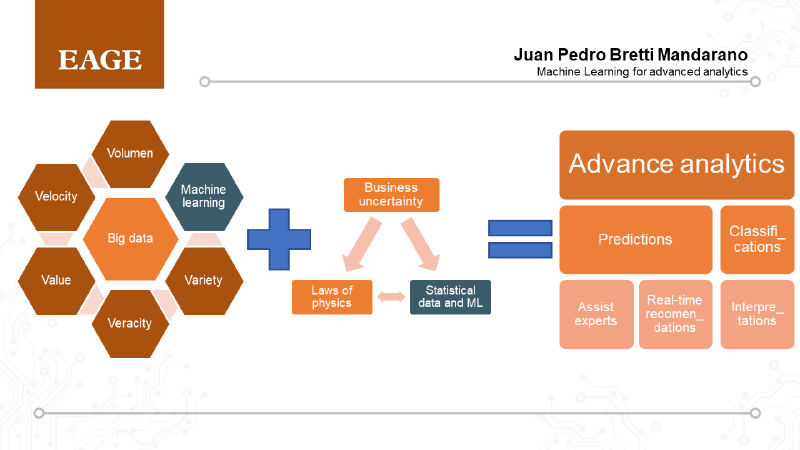
Let me share some of the thoughts shared at EAGE Digital 2022.
Today big data is defined after multiple V:#
Volume#
Data is abundant.
- Size measured not in KiB, MiB, more in TiB
- But we only transfer 5% of what I capture at the sensors
Veracity#
- Need a good data, to build a good model
- Good data should have quality, including control of missing data, low noise
Usually, one limitation to this veracity is who captures the data, is not the one who uses it. So has no incentive to improve it.
Variety#
The variety is not only in the available data, but also in the way we use it.
For example, let’s consider the definition of well for a reservoir engineer, production engineer, or geologists. For sure all have a different approach, and with that a different use of the data.
To help capture the variety, we have today:
- Data lakes
- Structure and unstructured
Velocity#
Data can be captured 1 per second, day, month…
Today, cloud computing, IIoT, 5G (or 3G when available), encryption, and batch or real-time is helping to improve the data frequency flow.
Value#
Data must be useful.
Data is an asset for the company
Machine learning#
The sixth side of the big data is how to use this valuable information to create a data-insights-driven decision company.
Business problems#
Don’t get in love with technology, get in love with the problem.
When you think about the problem, you don’t mind about the owner of the data
Laws of physics We know the fundamental and empirical methods to solve technical problems.
With the availability of Machine Learning, we do not need to bend what we know.
We are just trying to expand what we know, using data.
Statistical data ML The ease of Python and the multiple libraries available allow everyone to build a decent machine learning model.
As was discussed in the conversation between Cann and Crompton:
- Python is no longer an animal
- R not a letter
- Amazon, not a river
ML is helping to break silos because I’m combining all disciplines data.
ML is helping to find descriptive and predictive models to solve our business problem. To do so, we need to use our current specialists to build statistical models that follow their knowledge.
Advanced analytics#
Advanced analytics is helping to make predictions in seconds. Always knowing the degree of uncertainty.
It is helping to detect and classify patterns never though.
Challenge your experts to rethink the solutions.
For example, in the fields of:
- Predictive maintenance
- Water breakthrough
- Well interference
- Plunger lift dashboards and recommendations
- Petrophysics
- Seismic interpretation
- Realtime monitoring, modelling and recommendations
- Data integration, between multiple sources
- Energy efficiency
- Drilling bottom hole assembly design
- Drilling ROP optimization
- Connection time in a well drilling operation
Most important, never forget about 3 things:#
- Every advanced analytics model should have a monetary impact on the business.
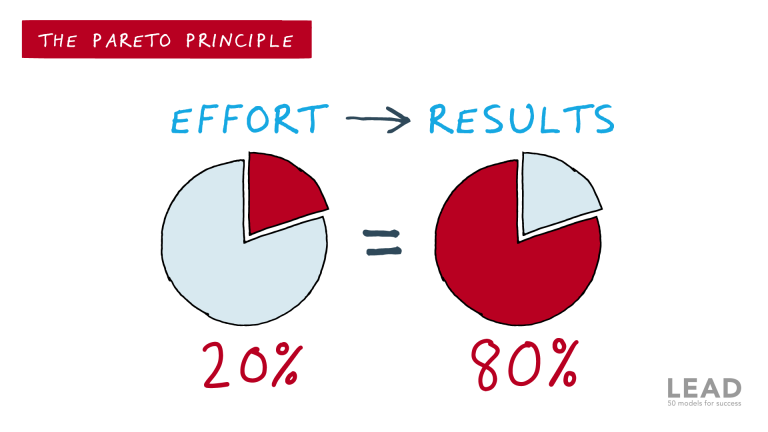
- Sometimes is good to apply a Pareto and check how the 20% of the model complexity could lead to the 80% of the solutions.
- The best solution is the quickest one, but the one that solves the problem. Do not oversimplify.
Additional references: